
I’ve been thinking a lot lately about the story of William Herschel, an astronomer who wanted to look at the sun. An expatriate composer living in Bath, Herschel had no formal training as a scientist but fell into it through sheer curiosity. Buying himself a telescope and various instructionals, he quickly became obsessed, grinding his own mirrors and lenses as he expanded his horizons. In 1781 he discovered Uranus, a bewildering accomplishment which saw him appointed as the King’s Astronomer.
In order to study sunspots, he had tried using different colours of darkened lenses to reduce the direct sunlight on his eyes and discovered, by chance, that some colours conveyed heat and little light, others light and little heat. To determine whether one colour of light would heat or illuminate more than any other, he used a crown glass prism (like Newton before him) to split white light across a tabletop. Using a board with a slit just large enough for one band of colour to pass through at a time, he measured the temperature of each stream landing on the table. His suspicions were true: colours across the spectrum seemed to register different temperatures across a distribution. But he also noticed that temperature readings beyond the table, past the stream of visible red light, were hotter still: the heat of invisible ‘infrared’ radiation. He had made a major discovery, without even realising it: that light and heat were each expressions of the same electromagnetic spectrum.
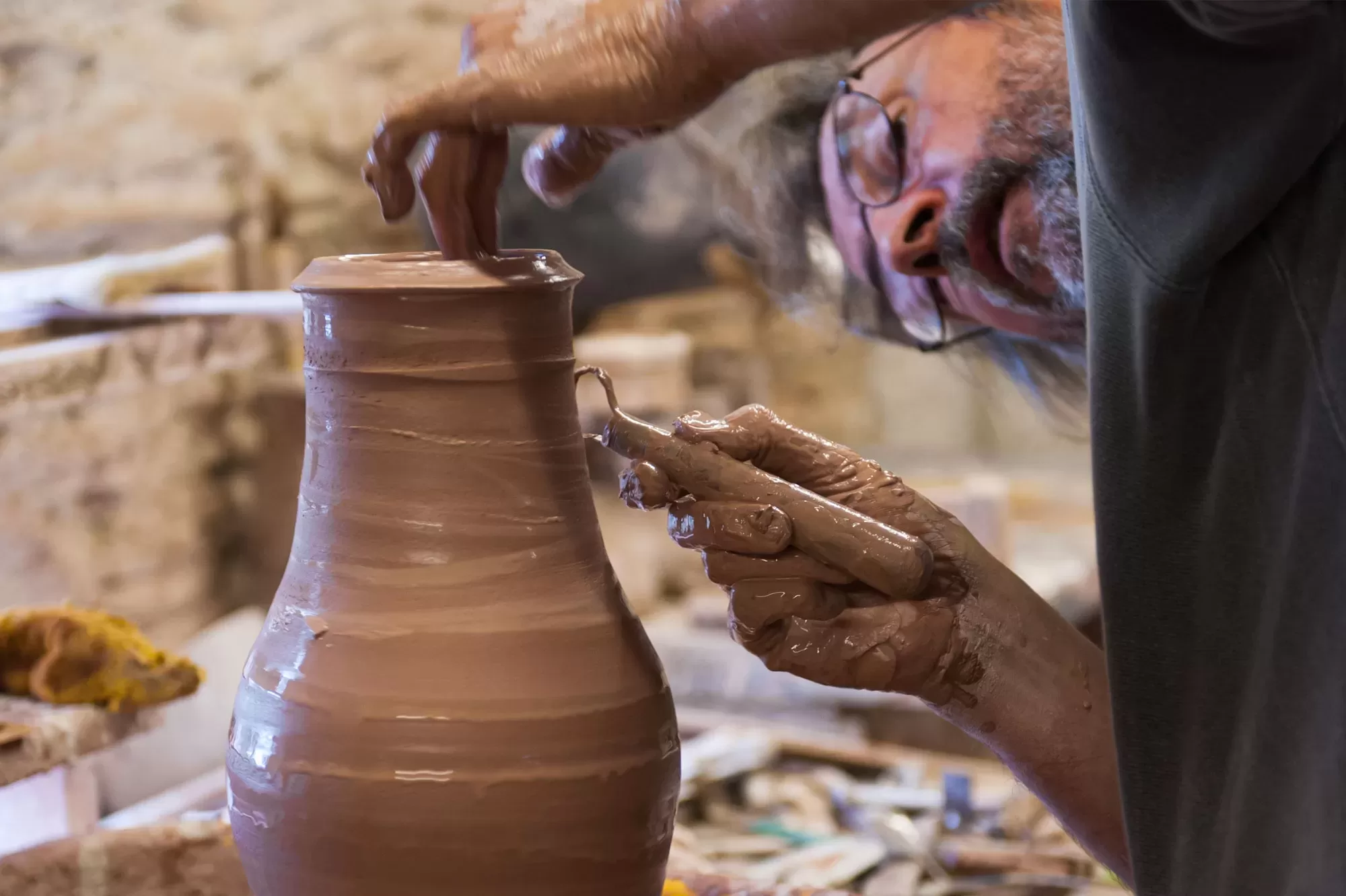
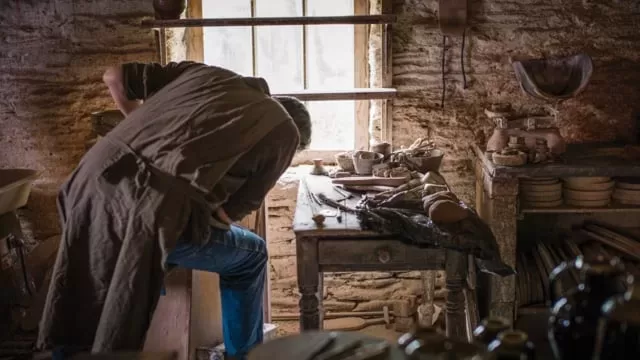
 Phil Rogers in his Rhayader studio, 2014
What does Herschel’s story have to do with studio pottery? Very little on the surface of it – except that this image of him scrabbling away in the dark, with makeshift equipment, building on the work of those that came before him, seemed to me an oddly appropriate metaphor for the trials and tribulations of the workshop, as the potter Phil Rogers once described them to me. Phil, like Herschel, was an artist first. He had no formal training as such and was largely self-taught, learning more from the pots of others he liked to call his ‘absentee tutors’. But pottery, he would stress, is a scientific art: multidisciplinary, dependent on the hard-won knowledge of others, the greater part of which involves no creativity at all – whether that be the ‘back-breaking drudgery’ of wedging clay, mixing glazes, or stacking piles of wood.
At the heart of good pottery, Phil would say, was the challenge ‘to succeed by daring to fail’. In the end Herschel was not convinced by his own data; he left the topic some years later, dissatisfied, without realising the significance of what he had found. But in his investigations he had built upon Newton’s findings, and paved the way for future scientists to do the same with his own. The potter Bernard Leach, borrowing from William Blake’s Proverbs of Hell, would say you have to ‘drive your cart and your plow over the bones of the dead.’ Phil, paraphrasing Isaac Newton, put it rather more tactfully: ‘We are all, in this line of work, standing on the shoulders of giants.’
 Buncheong bowl, slip on dark clay with clear glaze
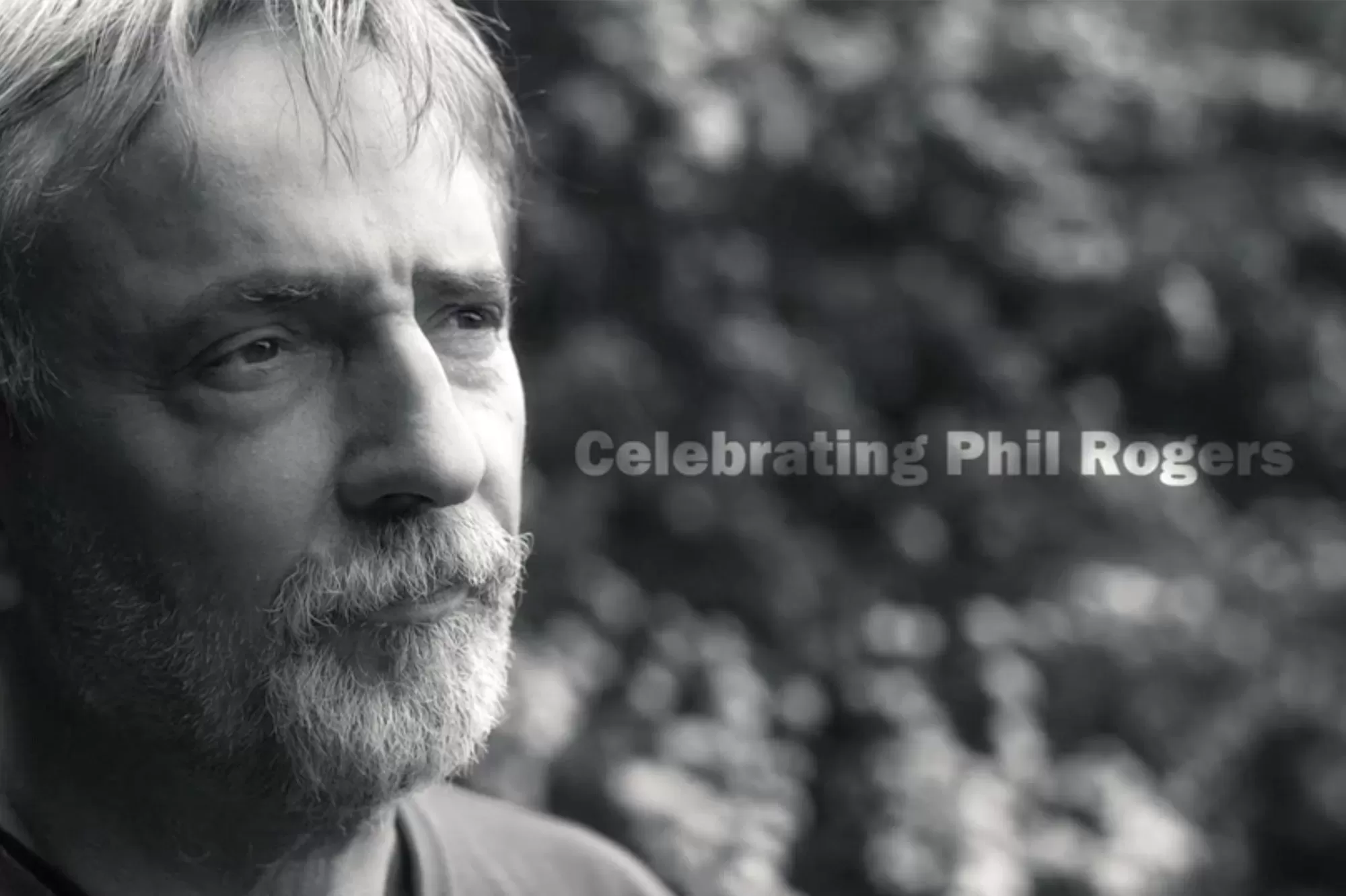
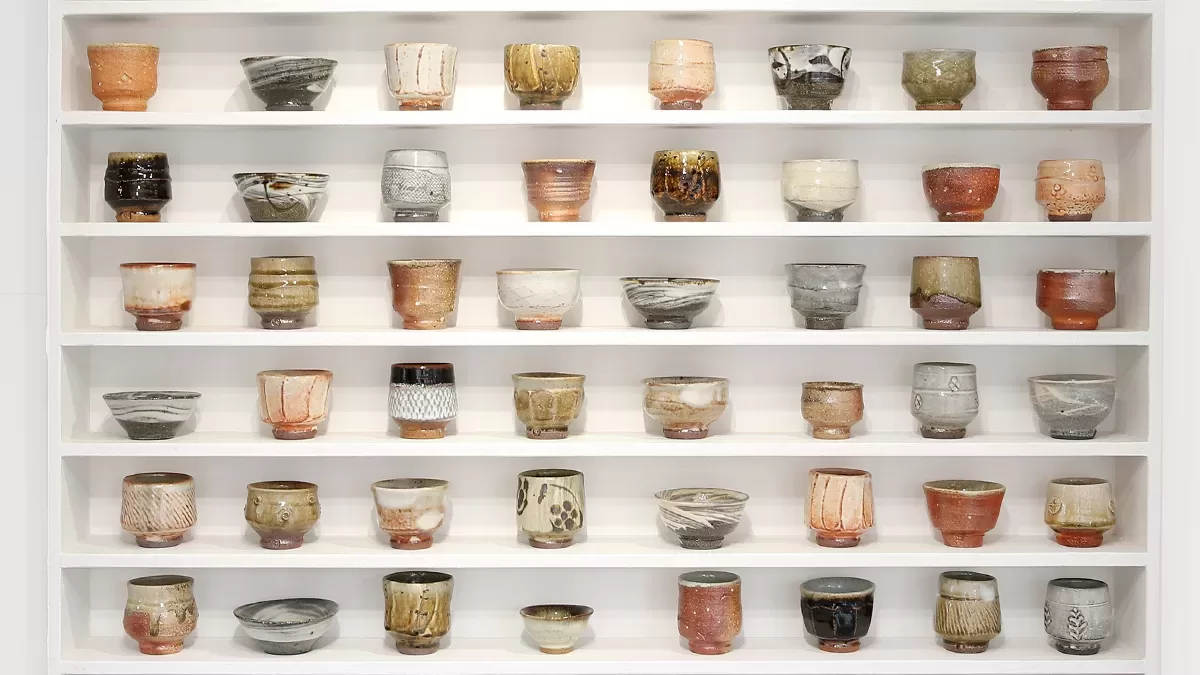
This winter will mark five years since Phil passed away. I would have been 10 or 11 when I first met him, slightly in awe of his giant frame and the gentle voice that didn’t match it. He seemed to have stepped out of an Asterix book, or the Welsh Rugby starting fifteen. We had many of his pots at home, but I think I knew him best from the yunomi and guinomi stacked in cupboards and on mantelpieces about the house. The names alone of these unpretentious and tactile little drinking vessels indicate the broadly Anglo-Oriental, cross-cultural vocabulary of forms and glazes with which he typically worked, but that label alone does little to describe the surprising deftness of the fingers and thumbs that shaped them. Phil brought extraordinary variety and sensitivity to scale in these pots that seemed counter to his huge hands, and which he knew, proportionate to a vase or medieval jug, would bring him little financial return. As we look back at his work in years to come, that gentleness and sympathy at small sizes will remain a large part of his legacy.
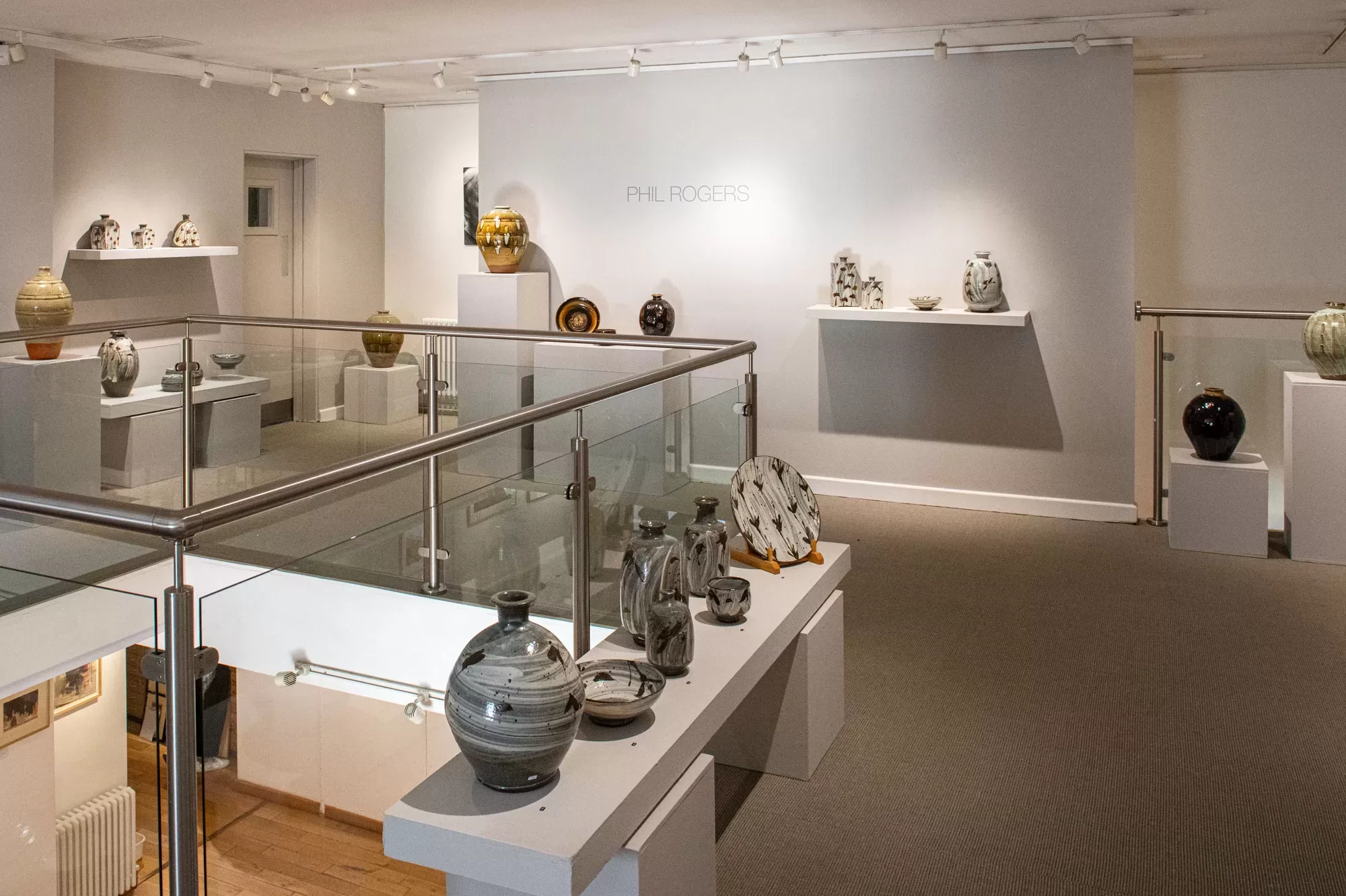
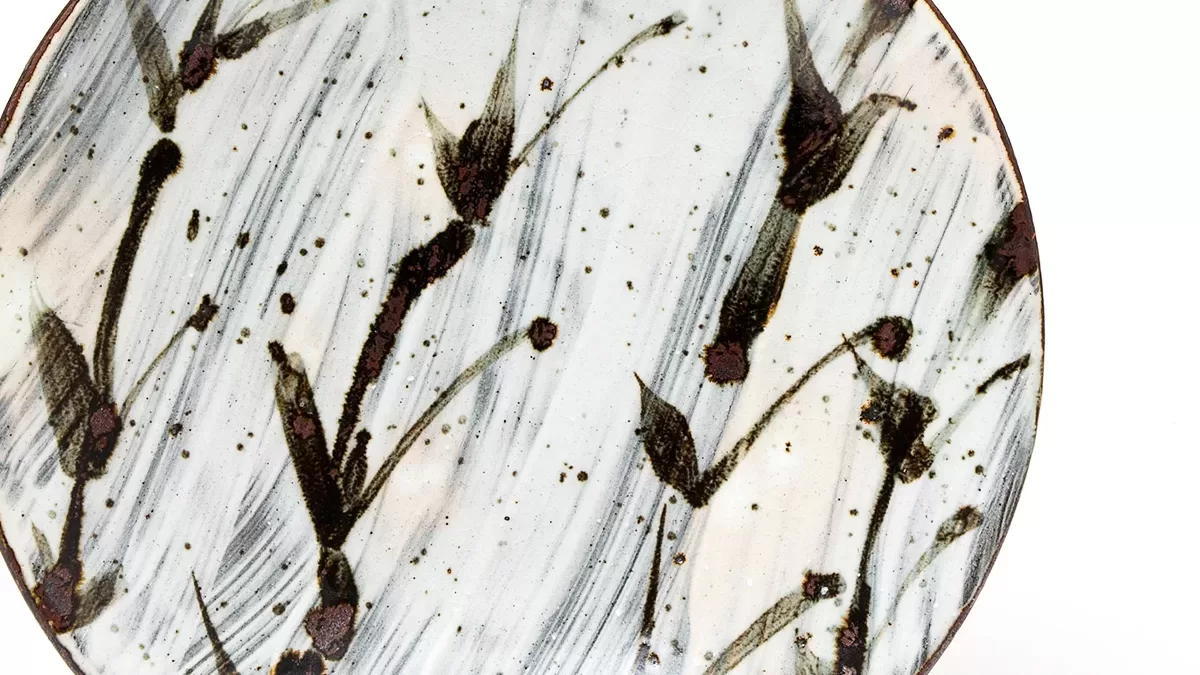
Phil was a big man, and with that came big opinions about how his craft was practised and promoted. His vocal distrust of the drift in ceramics editorials towards promoting ‘sculptural’, fine-art-adjacent work and his forthright railing against the minimalist trend of the 2000s for what he described as ‘anaemic’, thinly-thrown grey and white stoneware earned him as many adversaries as it did friends. For what it’s worth, from our own conversations I suspect Phil’s opinion on the broad church that ceramics has now become was more nuanced than his more dogmatic broadcasts would suggest. This public-facing aspect of his life (he was a four-term Chair of the Craft Potters Association) belied the softness that he expressed in his pots, and which often came out in private gestures. In 2014, while visiting Phil’s exhibition at the Goldmark Gallery, I mentioned that I was getting married later that summer. When I returned from my honeymoon several weeks later, I found wrapped in brown paper a stack of seven plates with beautiful calligraphic designs dashed across their surface, their slightly umbrous nuka glaze reminiscent of traditional Shodai pots from Japan. When I called to thank him, he explained that whenever he made gifts of sets of plates he would try to make seven, ‘just in case someone breaks one doing the washing up.’ Shamefully, I’m down to five.
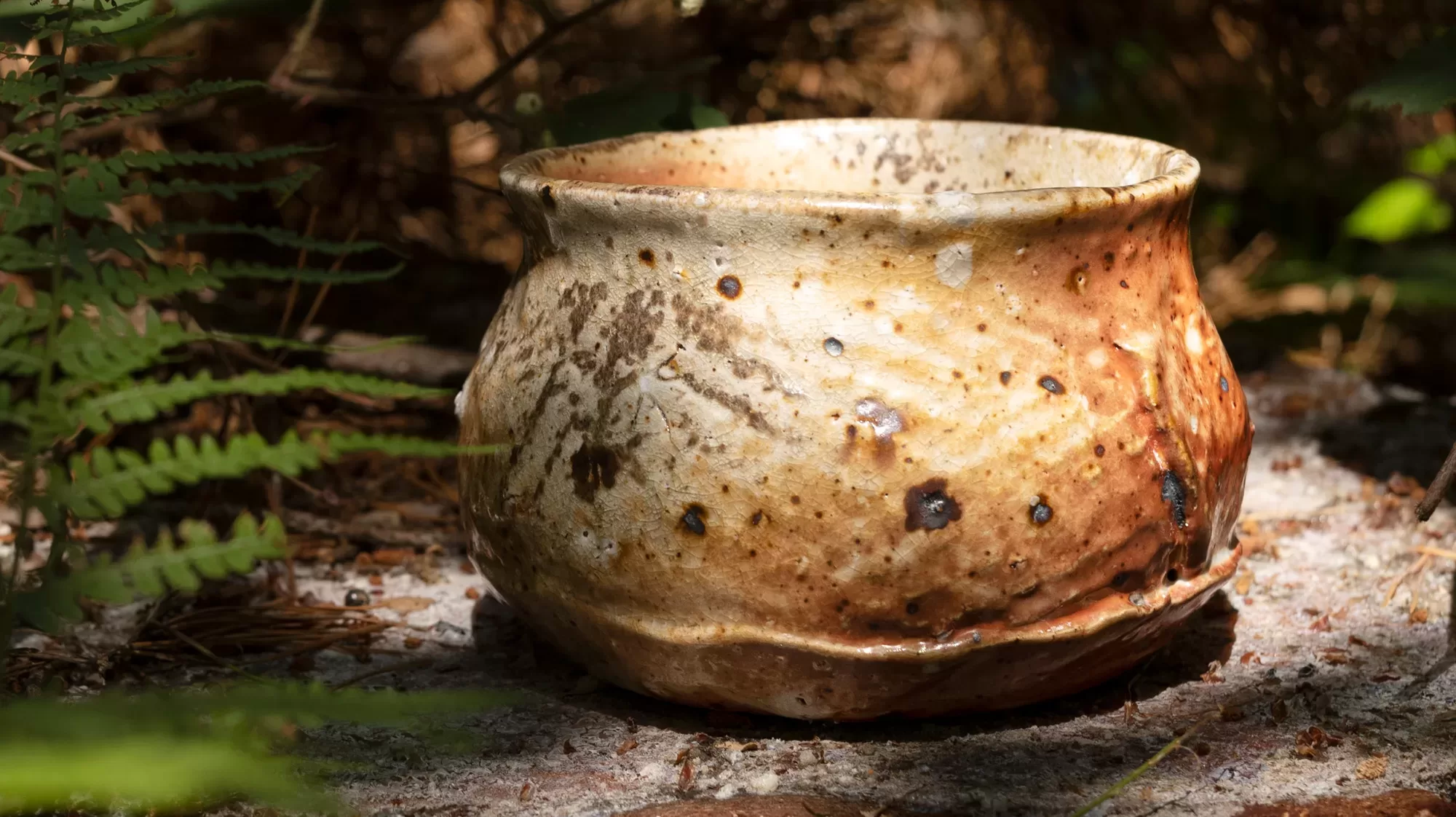
 Wood-fired Shigaraki-style bottles
A close look at any of Phil’s pots will tell you he had a great many heroes, from renowned studio potters to unknown craftsmen. English slipware, German salt glaze, Dutch-American settlers pots, Joseon Korean pottery – each fed into his repertoire. But more than any other potter, more than Bernard Leach, whose A Potter’s Book had set him on his path as a largely self-taught student potter, Phil admired Hamada. In the great game of composers versus interpreters, Hamada, like Leach, falls awkwardly between the two. He was not strictly an innovator: he did not, like the artist-potters who came after him, aggressively reshape pottery in his image; neither did he revive a tradition, like his contemporaries in Bizen and Mino, so much as invent one anew in the sleepy town of Mashiko, taking the local clays and glazes he found there and combining them, with great dexterity, with features drawn from Okinawa and elsewhere. His real legacy was of bridging traditions, cultures, borders. Phil was convinced there was an element of genius to his work: an intuitive gift that found articulation in the tension in a bowl, from rim to foot, or the placement of a motif across a press-mould bottle face – features he sought to replicate in his own work. I think he recognised, too, that this genius extended to the management and marketing of Hamada’s image too, carefully extricating himself from the ‘anonymous’ tradition of Mingei folk crafts to find fuller artistic expression elsewhere.
Phil used to call his inheritance from Leach and Hamada ‘more a genre than a tradition’. It’s an important distinction, particularly when we look back at Hamada’s early role as an ‘Intangible Cultural Property Holder’ (more colloquially, a ‘Living National Treasure’). While his contemporaries, like Toyozo Arakawa and Munemaru Ishiguro, were awarded the same titles for reviving or preserving particular types of historical work, Hamada’s honour was for the more elusive ‘Mingei (‘folk craft’)’ – neither a technique nor a catalogue of forms, clays or glazes. Phil knew that Hamada’s contribution was less about the preservation of long-held practices and more the art of an individual – an expression of soul, essentially, that could have been allied to any one tradition or another and found something to say within it. While he was himself a ‘preserver’ of sorts, through his much-loved textbooks on Ash Glazes (1992) and Salt Glazing (2003), the most important facet of a potter’s work remained, for him, its ‘spirit of adventure’, irrespective of process.
 Tall ash glaze vase with applied pellet decoration
Phil used to call his inheritance from Leach and Hamada ‘more a genre than a tradition’. It’s an important distinction, particularly when we look back at Hamada’s early role as an ‘Intangible Cultural Property Holder’ (more colloquially, a ‘Living National Treasure’). While his contemporaries, like Toyozo Arakawa and Munemaru Ishiguro, were awarded the same titles for reviving or preserving particular types of historical work, Hamada’s honour was for the more elusive ‘Mingei (‘folk craft’)’ – neither a technique nor a catalogue of forms, clays or glazes. Phil knew that Hamada’s contribution was less about the preservation of long-held practices and more the art of an individual – an expression of soul, essentially, that could have been allied to any one tradition or another and found something to say within it. While he was himself a ‘preserver’ of sorts, through his much-loved textbooks on Ash Glazes (1992) and Salt Glazing (2003), the most important facet of a potter’s work remained, for him, its ‘spirit of adventure’, irrespective of process.
More than chasing novelty, I think Phil was wary of staving off stagnation, knowing that the path he had chosen was narrow, making nuance and variation challenges in themselves. Like Hamada, returning time and again to the same broken straw motif with his brush, there was a sense that in each repetition a different response might come about: that the same pot at one time could represent or embody some quite different feeling when produced at another. Phil was not interested in newness for newness’ sake. Novelty for him meant more local challenges: could an equivalent of Shigaraki clay or Korean Buncheong decoration be formulated from what he had at hand? Could they retain the qualities of the original, while speaking of something specific to his very different geographic and cultural location in 21st-century mid-Wales?
 Yunomi, ash glaze over white slip in incised decoration
As Phil had noticed, the word ‘traditional’ sometimes inures us to what was really going on in such exercises. In one exhibition of his work I remember being strangely taken with an otherwise unassuming pot. A medium-sized vase, the walls slightly concave, with squared shoulders and a wide, open mouth with a pronounced lip, over which parchment could be drawn and tied to keep contents sealed. The body had been incised with little flicks of a tool, nicking out triangular hollows that had filled with glaze and which capped swiftly and thinly incised lines, together resembling grasses in the wind. The glazes were ash – a cool, glassy elm and a darker pine, in this instance, each over a loosely-brushed white slip, so that the grass motifs seemed to dance in, out, over and between their breezy background.
This form was an Albarello vase: a medicine jar, once richly decorated in the colourful Islamic motifs of Iraq, Syria or Moorish Spain, and later adopted by Italian craftsmen during the Renaissance, who realised it could also have a decorative capacity and become something altogether more luxurious – a history lesson that function and form are not sealed together, but sometimes shifting out of step. Phil’s pot still retained its vestigial lip, which now serves no purpose, but without which it would appear bald and unfinished. The same form (slightly squatter) was a favourite of Hamada’s, who enjoyed the hieratic pride of its open mouth.
Here was a pot, then, that brought together history from Spain, the Middle East, and quattrocento Italy, via a Japanese 20th century potter, enlivened with 16th century Korean decorative techniques and ash glazes sourced from local Welsh woodland.
 Phil throwing a teabowl in his studio, 2014
Bernard Leach, reflecting 50 years after he and Hamada first came together in England in 1920, described how cultural blending on such a scale was a new phenomenon specific to the modern-day studio potter. In their own experiments, they had been ‘servants of something greater than ourselves’, a ‘slowly evolving interplay and maturity of man. By which I do not mean a grey internationalism obliterating the local colour of each component people but an endless series of combinations determined by the depth and truth of creative minds answering the questions and conditions which surround them.’
‘As each of us lived into that different world, our own was enriched and enlarged. We also learned to see our own civilisation from outside with the long view of half a world away. This made our homecomings strange as well as familiar and left both of us for the rest of our lives with the task of accepting or rejecting concepts, shapes, textures, colours, patterns and techniques of pots from East and West. This is part of the responsibility of an artist of our time. It was never the task of an individual potter before our time….Today the individual potter has to carry this responsibility on his own shoulders. In other words, he has to be a recreative artist.’
The crisis for the traditional potter comes when that tradition itself is considered passé, dry, extinguished. What is there left to say in the Leach-Hamada vein? For Hans Coper, working in the wake of Leach and Hamada’s studio pottery movement but finding its precepts out of step with post-war metropolitan living, the potter’s practice meant getting comfortable with existential uncertainty. ‘Practising a craft with ambiguous reference to function one has occasionally to face absurdity,’ he wrote in the 1960s. ‘More than anything, like a demented piano tuner, one is trying to approximate phantom pitch. One is apt to take refuge in principles which crumble.’
 Large wood-fired vase in Shigaraki-style clay with ash glaze and impressed stamp decoration
More than several of his contemporary ‘Anglo-Orientals’, Phil also recognised how ill-suited those same principles were to the pace and demands of modern life, though he remained more committed to them than Coper. Growing out of Leach and Hamada’s Mingei philosophy, these were principles of beauty in the everyday object, in opposition to factory methods yet still tied, indirectly, to the original practice of pottery as repetitive work – ideals that placed those who followed them squarely in that dangerous and populous hinterland between fine art on the one hand and production pottery on the other.
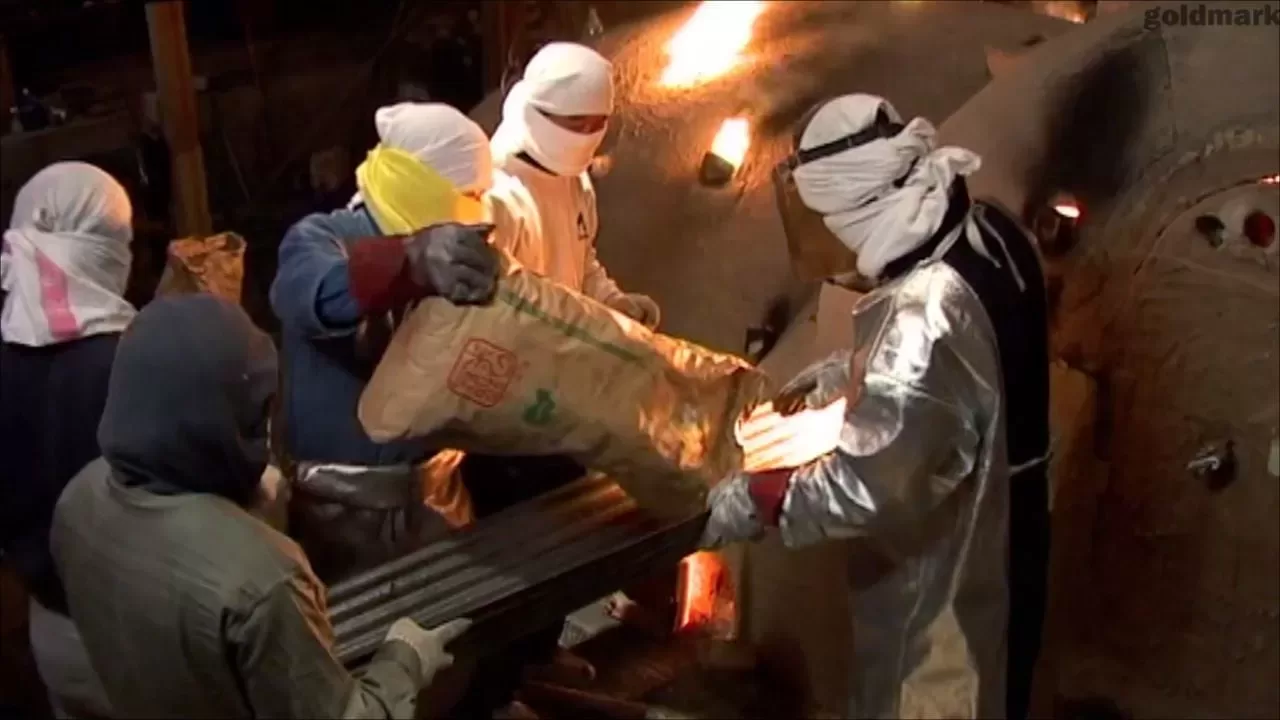
Studio pottery at this scale is a proclamatory art: the work is produced in greater quantities than most painters or sculptors could ever achieve – even Hamada could make 10,000 pots a year from his main kiln. Consistency – hardly the sexiest word in art criticism – becomes, in the art of functional studio pottery, an important marker of quality and prowess: Hamada (as far as Phil was concerned) famously never made a bad pot (or certainly hid or disowned them well enough that they are seldom attributed to his name). It is consistency that prevents the calamitous venture of being a potter from becoming unsurvivably expensive, and it is undoubtedly the source of its greatest frustrations – the principal reason why really good potters tend to hit their stride in later years, when there has been enough time to learn mistakes and trial, test and refine. And so potters are judged not just on their ‘masterpieces’, but on a deeper kind of attitude embodied by their career: a way of life, for want of a better term. The earthen tones of oatmeal, ash and iron glazes which ceramicists of the 1970s and ‘80s reacted so strongly against (and quite understandably) were not solely an aesthetic choice; they were tied up with moral and sensible choices too, an ethical principle that ‘to take from what is on offer is enough’, to enjoy the immediacy of what could be dug from the ground. Today such principles remain alive and well, from urban movements promoting the use of recycled materials in glazes to remoter, rural programmes like the Bornholm Wild Clay project, established by Phil’s one-time apprentice Anne Mette Hjortshøj. As she would be quick to point out, this is not a revolution. Wild Clay used to be called just ‘clay’, and digging it out and blending it with materials and minerals available to hand was what any potter did, what tied them to their sense of place, and which collectively supplied a distinct character to their work. A person in communion with the matter of place, and from that place and matter a particular vocabulary derived – of colours, textures, forms and scales.
 Phil Rogers outside his Rhayader studio, 2014
It is the mark of great pottery that, consistently, the work produced somehow contains and distils this attitude, in all its nuance, with the same ease that it might contain and supply food or drink, as Phil’s work always did. Do his pots have a ‘Cambrian’ feeling? Many of his Welsh collectors seemed to think so. A favourite technique involved displacing straight lines around the belly of a pot to give them a lilt like the Welsh language, or like echoes of the hilly landscape beyond his Rhayader workshop window. To me, such lines recall Dylan Thomas’ ‘force that through the green fuse drives’ all living things, a poetic circle captured in the cyclical nature of ash glazes, and of pottery more broadly: earth shaped and hardened by the burning of wood fuel, all to return to the soil again one day.
Leach compared Hamada to the tree ‘growing from his own earth and roots upwards and outwards, and like a tree flowering and shedding seed back to earth again…Now his pots are known and admired all over the world for like trees they have sap in them – the natural life force which everybody shares, but few use wisely.’ Phil’s pots remain too, evidence of his own lively character, his sensitivity to eye, touch and use, the guiding principles that he protected and maintained as times changed around him, and which still to us seem worth preserving for generations to come.